
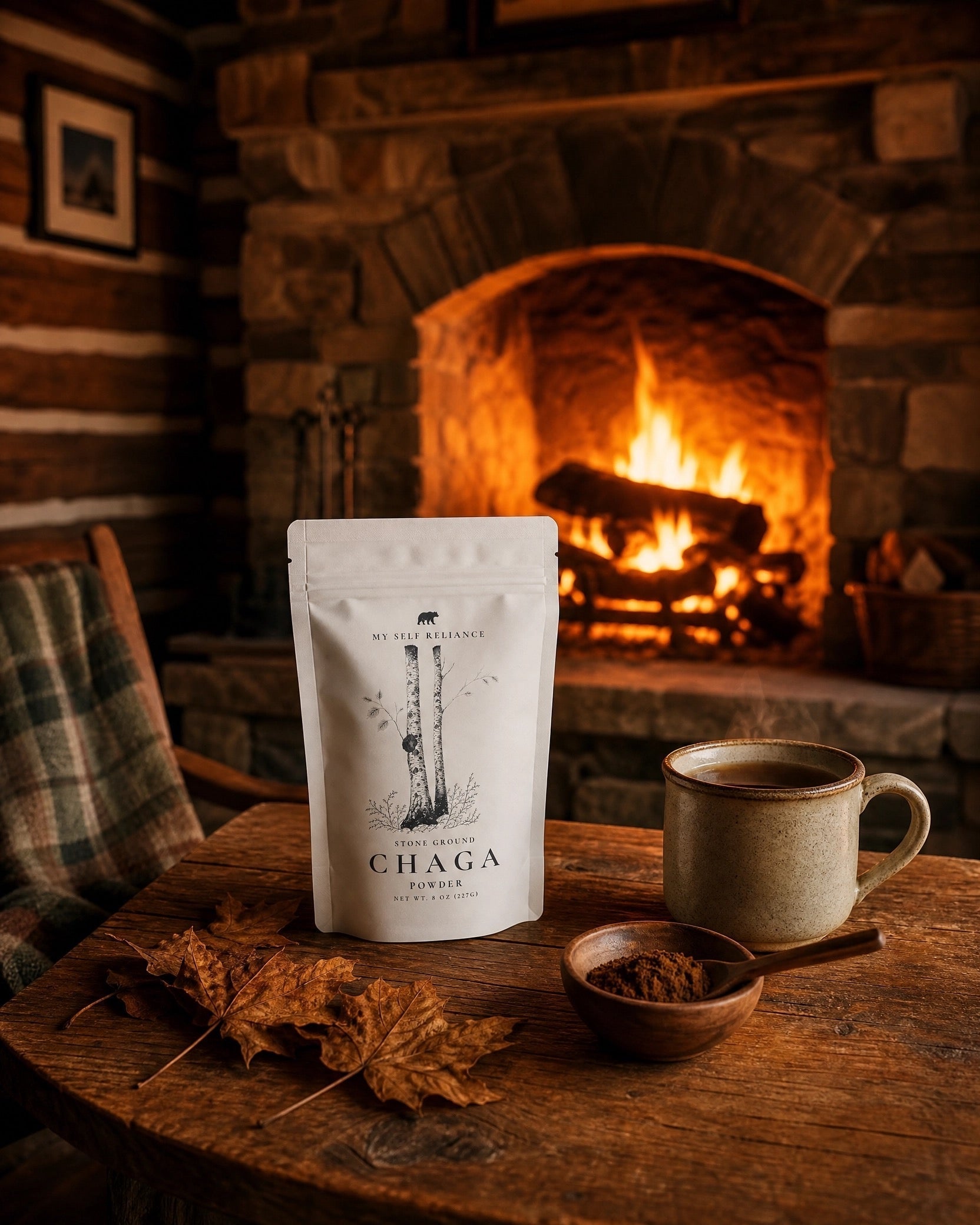
Brewing chaga chunks into tea is the classic approach, and it's a good one. But powder opens up a different set of possibilities. It dissolves directly into liquids, blends into foods, and works in situations where a long slow simmer isn't practical. It's the same chaga — just in a form that fits differently into daily life.
What follows is an overview of the things I find most worth making with it. Each one is simple, uses ingredients that belong in a self-reliant kitchen, and lets the chaga do what it does without overcomplicating things.
 Powdered chaga
A Word on Powder vs. Chunks
Before getting into what you can make, it's worth understanding how powder behaves differently from chunks — because the extraction works differently and that affects what you get in the cup or the pan.
With chunks, you're doing a long decoction — hot water slowly pulling compounds out of the dense fibrous mass over time. With powder, the surface area is dramatically increased, which means extraction happens quickly. A teaspoon of chaga powder stirred into hot water will dissolve and release its water-soluble compounds almost immediately. You don't need to simmer for an hour.
The tradeoff is that powder gives you less control over the strength of individual brews, and the fine particles can make the liquid slightly gritty if not whisked well. A small whisk or a milk frother solves that. The upside is convenience and versatility — powder goes places that chunks can't, including into batters, smoothies, and spice blends.
In the Cup
The most natural starting point. Chaga powder dissolved in hot water is the fastest route to a cup of chaga tea — no simmering, no straining, just a teaspoon whisked into near-boiling water. From there, a handful of variations that have all earned a regular place here.
Recipe 01
Chaga Tea — The Simple Version
The foundation. One teaspoon of chaga powder whisked into a mug of hot water — not boiling, just off the boil. That's it. From here you can add a little raw honey, a splash of cream, or leave it completely alone. The flavour is earthy, smooth, and grounding. It's the kind of thing that becomes a morning ritual without you deciding to make it one.
Recipe 02
Chaga Maple Latte
Chaga powder whisked into hot water, finished with frothed milk and a pour of real maple syrup. The maple rounds out the bitterness in a way that feels entirely natural — both things come from the same northern landscape and they belong together in the cup. Use whole milk for the best froth. A milk frother makes this effortless; a small whisk works too.
Recipe 03
Chaga Mocha
Equal parts chaga and unsweetened cocoa powder whisked into hot water, with a shot of strong coffee stirred in and a little cream floated on top. The three flavours — earthy chaga, dark cocoa, bitter coffee — are closely enough related that they reinforce each other rather than competing. Sweetened lightly with maple syrup or left unsweetened, this is a serious morning drink for people who mean business.
Recipe 04
Iced Chaga Cold Brew
Chaga powder stirred into cold water and left in the refrigerator overnight. The cold extraction produces a smoother, lighter brew than hot water — less intense, more subtle, with the same underlying earthiness. Serve over ice with a splash of maple water or a small pour of cream. A good warm-weather alternative when a hot cup isn't what you're looking for.
 Chaga maple latte
In the Kitchen
This is where chaga powder gets interesting. The flavour — earthy, slightly bitter, with a faint chocolate-adjacent quality — integrates well into a range of foods, particularly anything with dark, warming, or bitter notes of its own. It doesn't assert itself aggressively; it deepens and enriches what's around it.
Recipe 05
Chaga Overnight Oats
Rolled oats, chaga powder, a spoonful of nut butter, maple syrup, and milk — stirred together and left in the refrigerator overnight. The chaga absorbs into the liquid as the oats soak, becoming part of the base flavour rather than something you notice separately. In the morning, top with whatever the season offers — fresh berries, sliced apple, toasted seeds. A genuinely effortless breakfast with more going for it than it looks.
Recipe 06
Chaga Smoothie
Frozen banana, a tablespoon of cocoa powder, a teaspoon of chaga powder, a spoonful of almond butter, milk or oat milk, and a pour of maple syrup. Blended smooth. The banana provides sweetness and body; the cocoa and chaga work together in the background, giving the whole thing a depth that a plain banana smoothie doesn't have. It tastes like something that should be more complicated than it is.
Recipe 07
Chaga Energy Balls
Rolled oats, chaga powder, cocoa powder, nut butter, maple syrup, a pinch of salt, and dark chocolate chips — mixed together, rolled into balls, and chilled until firm. No baking, no fuss. These keep well in the refrigerator for a week and travel easily. The kind of thing you make on a Sunday and reach for through the week when you need something real before heading out into the cold.
Recipe 08
Chaga Chocolate Bark
Good dark chocolate melted down, chaga powder stirred in, poured thin onto a lined tray and finished with flaky sea salt and whatever you have on hand — dried cranberries, toasted pumpkin seeds, roughly chopped walnuts. Set in the refrigerator until firm, then broken into pieces. The bitterness of the dark chocolate and the earthiness of the chaga are so close in character that they read as a single flavour. The salt makes everything come forward. A good thing to have around.
 Chaga energy balls
Baked and Cooked
Chaga holds up well to heat in baking — the compounds most sensitive to temperature are the ones that degrade above boiling point, and most baking happens at temperatures that are managed enough to preserve the majority of what you're after. More importantly, baked goods are one of the easiest ways to bring chaga into a household where not everyone is reaching for a cup of tea.
Recipe 09
Chaga Banana Bread
A straightforward banana bread with chaga powder worked into the dry ingredients alongside a good measure of cocoa. The result is darker than a standard loaf — almost brownie-like in colour — with a flavour that's richer and more complex than plain banana bread without being obviously different to anyone who doesn't know what's in it. Good toasted, with real butter. One of the better uses I've found for overripe bananas.
Recipe 10
Chaga Granola
Rolled oats, chaga powder, maple syrup, coconut oil, a good handful of seeds and nuts, and a pinch of cinnamon — mixed, spread thin on a tray, and baked low and slow until golden and crisp. The chaga disappears into the granola in a way that's hard to identify separately but contributes something to the overall depth. Eat it with cold milk in the morning or straight from the jar when you're heading out the door. It keeps well in a sealed container for two weeks.
Recipe 11
Chaga Pancakes
A standard pancake batter with chaga powder and a spoonful of cocoa stirred into the dry mix. The pancakes come out slightly darker and earthier than plain ones — not dramatically different, but with more character. Served with real maple syrup, they're one of those breakfasts that feels like it belongs to a specific time and place. Saturday morning in the cabin, wood stove going, the kind of quiet that doesn't need filling.
Recipe 12
Chaga Spice Rub
Chaga powder combined with smoked paprika, ground black pepper, garlic powder, a little brown sugar, and coarse salt. Mixed together and stored in a jar. Applied to venison, wild boar, or a good cut of beef before grilling or roasting, the chaga adds an earthiness to the crust that reads as depth rather than an identifiable flavour. It's the kind of thing that makes people ask what's in the rub without being able to place it. Works particularly well on anything cooked over open fire.
A Few Notes on Cooking with Chaga
A teaspoon per serving is a reasonable starting point for most of these. Chaga powder has a strong enough flavour that more than that can start to dominate, particularly in lighter recipes. In baked goods, one to two tablespoons per standard batch is the range to work in — enough to be present, not so much that it takes over.
Pairing matters. Chaga's earthiness plays best alongside dark chocolate and cocoa, maple syrup, coffee, warm spices like cinnamon and cardamom, nuts and seeds, and anything from the forest — wild blueberries, dried cranberries, foraged mushrooms. It's less at home in very light or delicate flavours where it can read as muddy rather than complex. Work with its character, not against it.
And finally: use good chaga. The quality of the powder matters as much as it does with anything else you cook with. Wild-harvested, birch-grown chaga that's been properly processed will behave differently in the kitchen — better colour, better flavour, more of what you're cooking with it for — than a cheap cultivated product. It's worth starting with the real thing.
Available in the General Store
Wild-Harvested Canadian Chaga Powder
100% wild harvested by hand from the Canadian boreal forest. Grind your own or use as-is for brewing.
Shop Chaga Powder — $44.99→Follow the Journey on YouTube
I document the real life — the building, the growing, the hard winters, and everything in between — on the My Self Reliance channel.
Watch on YouTube →

Hinterlasse einen Kommentar
Diese Website ist durch hCaptcha geschützt und es gelten die allgemeinen Geschäftsbedingungen und Datenschutzbestimmungen von hCaptcha.