
Designing a Property From Scratch: How I Use Permaculture Zones
Where the cabin, the garden, and the woodshed belong, and why the answer starts with a year of watching before a single building goes up.
Somebody buys five acres, or forty, or a hundred and fifty like I did, and they stand on that land for the first time with the keys in their pocket and no idea where anything should go. The garden, the driveway, the cabin, the woodshed, the chicken coop, all of it is still just an idea, and the temptation is to start building the first week.
I understand that temptation because I gave in to it myself more than once, and I paid for it in wasted work and in buildings that ended up in the wrong place. So this article is about the system I use now when I think about a property, whether it is raw bush or an old farm. It comes out of permaculture, and specifically it is the idea of zones.
Watch the Land Before You Change It
The first rule I follow now is to observe before I build. A full year if I can manage it, and at minimum through the seasons that matter most, which here in the bush means spring melt and the middle of winter.
A piece of land tells you almost everything you need to know if you give it time. Where the snow melts first in April, that is your warm ground and probably your garden. Where the water sits for two weeks after the melt, that is not where the cabin goes, no matter how pretty the view is. Where the wind comes from in January, where the frost settles on a still night in September, where the deer cross, where the sun actually lands in December when it barely gets above the trees. None of that shows up on the survey, and none of it shows up on a sunny afternoon in July when you walked the property with the real estate agent.
I keep a notebook for this. Dates and observations, nothing fancy. It is the cheapest design tool there is, and it has saved me more money than any piece of equipment I own.
What Zones Actually Are
Permaculture has a reputation for being complicated, and some of the books do not help with that, but the zone idea is simple. You organize the property by how often you need to visit each part of it. The things you touch every day live closest to the door, the things you touch once a season live farthest away, and the wild land you mostly leave alone sits at the edge.
The numbers run from zero to five. Zone 0 is the house itself. Zone 1 is the ground right around it, the places you can reach in slippers with a coffee in your hand. Zone 2 is the daily rounds, Zone 3 is the weekly work, Zone 4 is the managed forest, and Zone 5 is wilderness.
Here is the part people get wrong. The zones are not neat rings on a map, like a target painted around the house. In real life they stretch and bend along your paths, your slopes, and your water. A spot fifty feet (about 15 meters) from the door but off the path you walk every day is effectively farther away than a spot two hundred feet down the trail you take to the woodshed. Zones follow your feet, not a compass, and the honest way to draw them is to live on the land for a while and notice where you actually go.
Zones follow your feet, not a compass, and the honest way to draw them is to live on the land for a while and notice where you actually go.
Zone by Zone at My Place
Lived examples are worth more than definitions, so this is how it works here.
Zone 0 is the cabin, and the design decisions start before the first log goes down. Mine faces south to catch the low winter sun, the wood stove sits in the center of the floor plan so the heat reaches everything, and the porch is deep enough to work under in the rain. The kitchen window looks out at the garden, which sounds like a small thing, but what you can see from the sink gets weeded and what you cannot see gets forgotten.
Zone 1 is everything within about fifty feet of the door. The herbs, the salad greens, the rain barrels, the day's split firewood, the tools I use constantly. Cali's spot is in Zone 1 too, right where she can keep an eye on the whole operation. The rule I use is simple. If I need it daily, or if it fails fast without attention, it lives here. Lettuce wilts in a day and herbs get skipped if the walk is too long, so they stay close.
Zone 2 is the daily rounds, the loop I walk once in the morning and once in the evening. This is where a chicken coop belongs if you keep birds, along with the greenhouse, the compost, the berry bushes, and the young orchard. These things need eyes on them every day, but only once or twice, so they can sit a few hundred feet out along a good path.
Zone 3 is the weekly work. The main crops, the potatoes and squash and corn that get planted, hilled, and left mostly alone between visits. On my property the sugar bush lives at this distance too, because for eleven months of the year it needs almost nothing from me, and then for four weeks in March it becomes the center of my life.
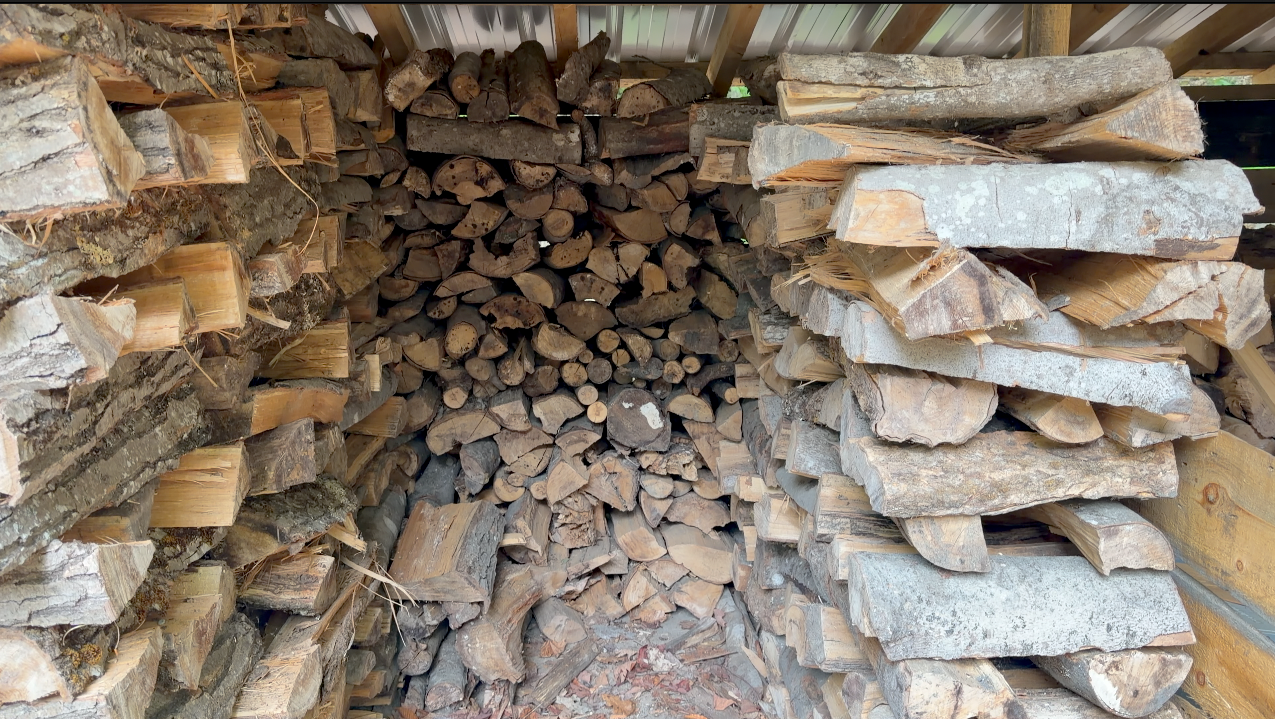
Zone 4 is the managed forest, and it is the zone I probably value most. It is where the ten or twelve cords of firewood come from every year, where I fell and mill timber for building, where I forage mushrooms and hunt. It is not wild, because I am shaping it constantly, thinning here, favoring an oak or a white pine there, but it runs on the forest's schedule rather than mine.
Zone 5 is the land I leave alone. On a big property that might be half the acreage, and on a small one it might be the back corner behind the brush pile, but I would keep some version of it no matter the size. It is where I go to see how the land manages itself when nobody helps it, and honestly, most of what I know about growing things I learned by watching ground I never touched.
Where I Would Start on a New Property
If I were starting over on raw land tomorrow, the order would be water, access, shelter, and then the zones from the inside out.
Water first, because everything else bends around it. Access second, because the driveway and the main paths are the skeleton the zones hang on. Shelter third, placed where the year of watching told you it belongs. Then Zone 1, done well, before anything else expands.
Water first, because everything else bends around it. I want to know where it comes from, where it goes in the spring, and where I can store it uphill of where I will use it. Access second, because the driveway and the main paths are the skeleton the zones hang on, and a path in the wrong place will distort every decision that comes after it. Shelter third, even if the first version is a wall tent or a small cabin you outgrow, placed where the year of watching told you it belongs.
Then I would build Zone 1 and stop. An eighth of an acre done well, with good soil, a tight fence, and a rain barrel, will feed you more reliably than five acres of ambition that gets away from you by July. I expand a zone only when the one inside it mostly runs itself, and that discipline is harder than any of the physical work, because the excitement of new land wants everything done at once.
An Honest Map of Your Own Energy
The longer I live this way, the more I think the zone system is really about being honest with yourself. It asks how much energy you actually have, not how much you wish you had, and it puts the demanding things where your energy naturally flows instead of where the view is best. A property designed that way carries you through the tired seasons, and there are always tired seasons.
So if you are standing on a new piece of land right now, or dreaming about one, I would give it a year of your attention before you give it a single building. The land has been working out its own arrangements for a long time, and it makes a better partner than a blank slate.
Walk the Land With Me
I document this lifestyle season by season on YouTube, and inside the Hearthside community we go further into property design, food, and building. If this way of thinking about land is useful to you, that is where the real conversations happen.


اترك تعليقًا
This site is protected by hCaptcha and the hCaptcha Privacy Policy and Terms of Service apply.